Why the Transfer Fee Is Only Half the Story
Every summer, headlines announce the latest blockbuster transfer. A player moves clubs for £60 million, £80 million or even £100 million, and the figure dominates media coverage and fan discussion.

But in reality, the transfer fee reported in the media is often only one component of a much larger financial commitment.
Behind every major transfer lies a complex financial structure involving agent commissions, signing bonuses, performance incentives, and accounting mechanisms that shape how clubs manage their finances.
Understanding these mechanics reveals an important truth about modern football: player transfers are not just sporting decisions – they are financial investments that must be carefully structured and managed.
For clubs operating under increasing financial regulation and competitive pressure, the ability to structure transfer deals intelligently can be as important as identifying the right players.
The Transfer Fee Myth
When fans hear that a club has signed a player for £60 million, the natural assumption is that the club has simply paid £60 million for that player.
In reality, the total cost of acquiring that player could easily exceed £120 million over the duration of the contract.
This is because the transfer fee itself is only part of the overall financial package.
A typical transfer can include:
- Transfer fee paid to the selling club
- Player wages over the contract
- Signing bonuses paid directly to the player
- Agent commissions
- Loyalty bonuses
- Performance-related incentives
- Image rights agreements
For example, consider a hypothetical £60 million transfer on a five-year contract.
If the player earns £200,000 per week, the wage commitment alone would exceed £52 million across the contract.
Add agent commissions and signing bonuses, and the total cost to the club can rise dramatically beyond the original transfer fee.
This is why clubs increasingly evaluate transfers based on total cost of ownership, rather than simply focusing on the headline fee.

How Transfer Fees Are Actually Paid

Another common misconception is that clubs pay transfer fees upfront in a single payment.
In reality, most transfers are structured through instalments spread over several years.
For example, a £60 million transfer might be structured as:
- £27.5 million paid immediately
- £16.25 million paid after 12 months
- £16.25 million paid after 24 months
These payment structures help clubs manage cash flow and maintain financial flexibility.
They also allow clubs to continue investing in players without needing large amounts of cash available immediately.
This instalment system has become increasingly common across European football, particularly as transfer fees have grown significantly over the past decade.
However, while payments may be spread out, the accounting treatment of transfers follows a different logic.
The Role of Amortisation in Football Finance
One of the most important concepts in football finance is amortisation.
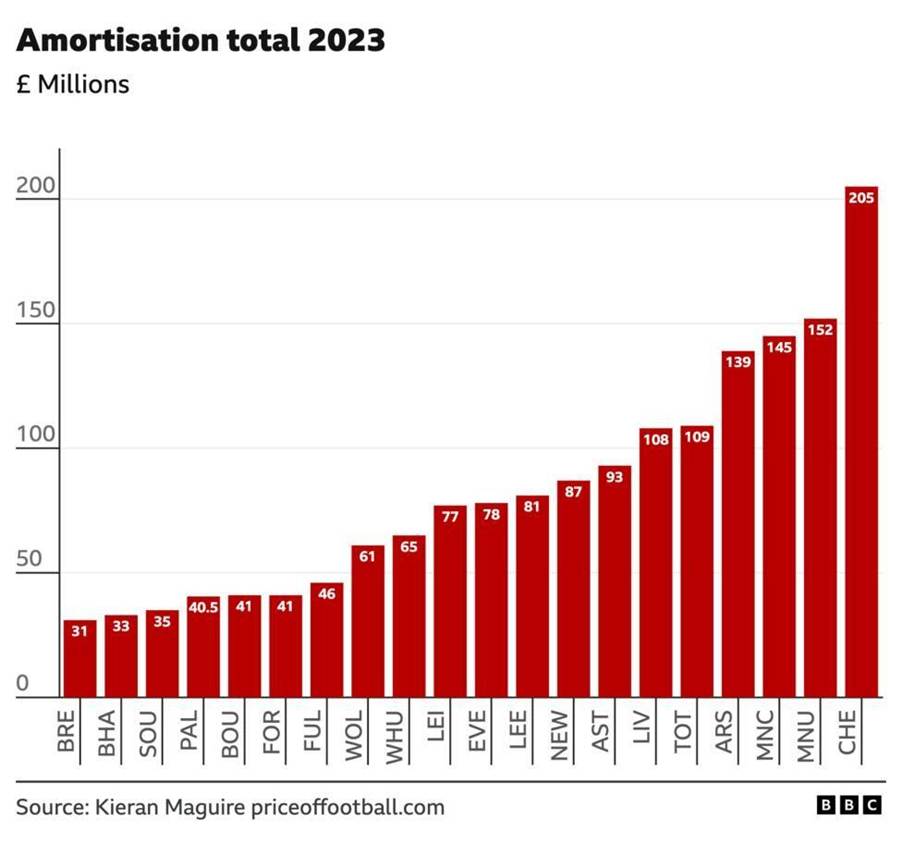
Amortisation is the accounting process that allows clubs to spread the cost of a transfer fee across the duration of a player’s contract.
For example:
A club signs a player for £50 million on a five-year contract.
Rather than recording the full £50 million as an immediate expense, the cost is spread evenly across the five years of the contract.
£50 million ÷ 5 years = £10 million per year
This means the club records an annual accounting expense of £10 million related to that player’s transfer fee.
This accounting mechanism is particularly important in the context of financial regulations such as the Premier League’s Profit and Sustainability Rules (PSR) and UEFA’s financial sustainability framework.
These regulations limit the losses clubs can incur over a defined period.
By spreading transfer costs over multiple years, clubs can invest in players while remaining compliant with these rules.
Contract length therefore becomes a critical financial lever.
For instance, a longer contract allows clubs to reduce the annual amortisation charge, lowering the immediate accounting impact of the transfer.
This dynamic partly explains why some clubs have experimented with unusually long player contracts in recent years.
The Influence of Agents in Modern Transfers
Another significant component of modern transfer deals is agent commissions.

Agents play a key role in negotiating contracts, facilitating deals between clubs, and representing players’ interests.
For these services, agents typically receive commissions that can range between 5% and 10% of the total value of the deal.
In high-profile transfers, agent fees can reach substantial figures.
For example, a large transfer could involve:
- A commission paid by the player
- A separate fee paid by the buying club
- Additional payments to intermediary agents involved in the negotiation
These payments reflect the influence agents can have in facilitating transfers and structuring deals.
In recent years, football authorities have attempted to introduce regulations to limit agent commissions and improve transparency in transfer negotiations.
However, agents continue to play a central role in the modern football ecosystem. Their influence often extends beyond a single transaction, as they may represent multiple players within a club or maintain long-term relationships with sporting directors and executives.
The Hidden Costs of Player Transfers

Beyond transfer fees and agent commissions, many deals include additional financial components that can significantly increase the overall cost.
Some of the most common include:
Signing Bonuses
Players frequently receive substantial signing bonuses when joining a new club.
These payments compensate players for committing to a long-term contract and can sometimes reach millions of pounds.
Loyalty Bonuses
Contracts may include loyalty bonuses payable if a player remains at the club for a specified period.
These incentives encourage contract stability while rewarding players for fulfilling the length of their agreement.
Performance Incentives
Contracts often include bonuses linked to performance metrics such as:
- Appearances
- Goals or assists
- Team achievements such as qualifying for European competitions
These clauses allow clubs to align financial rewards with on-field performance.
Sell-on Clauses
Selling clubs may negotiate sell-on clauses, entitling them to a percentage of any future transfer fee.
This mechanism allows clubs that develop young players to benefit financially if those players later move for significant fees.
Sell-on clauses have become particularly important for smaller clubs that rely on player development as part of their business model.
The Strategic Importance of Transfer Management
The complexity of modern transfer structures means that clubs must approach recruitment decisions from both sporting and financial perspectives.
A poorly structured transfer can create long-term financial challenges.

For example, if a player signed for a large fee fails to perform and becomes difficult to sell, the club may still be responsible for:
- High wages
- Remaining amortisation costs
- Contractual bonuses
This combination can make it difficult to move players on without incurring financial losses.
Several clubs have experienced the consequences of such situations, where expensive contracts and amortisation commitments have limited their flexibility in future transfer windows.
Conversely, clubs that manage transfers effectively can create a sustainable competitive advantage.
Recruitment strategies that combine strong scouting, financial discipline, and strategic planning allow clubs to maximise player value while maintaining financial stability.
Clubs such as Brighton & Hove Albion and Benfica have demonstrated how effective player trading models can generate both sporting success and financial sustainability.
Transfers as Financial Investments
Ultimately, modern football transfers should be understood not simply as sporting decisions, but as financial investments with significant strategic implications.
The most successful clubs are those that understand the full financial picture behind every deal.
They evaluate transfers not just on the player’s ability on the pitch, but also on:
- Contract structure
- Financial sustainability
- Potential resale value
- Commercial impact
As football continues to evolve as a global industry, the ability to manage these financial dynamics will become increasingly important.
For executives, sporting directors, and analysts, understanding the economics of transfers is now a fundamental component of running a successful football club.
For fans, recognising the complexity behind these deals offers a deeper appreciation of the business decisions shaping the modern game.
Because in modern football, the transfer fee is only the beginning of the story.
 Business of Football
Leave a comment